Canoe Polo Referee Signals Quiz
Test your canoe polo referee signal knowledge!
Instructions: Each question features an image and a description of a referee signal. Identify the correct English term for the signal, and type it in the answer box.
Answers are not case-sensitive. Minor spelling errors, and word permutations are accepted. E.g. "Cancelled Goal" and "gool cancelled" are both accepted.
Example
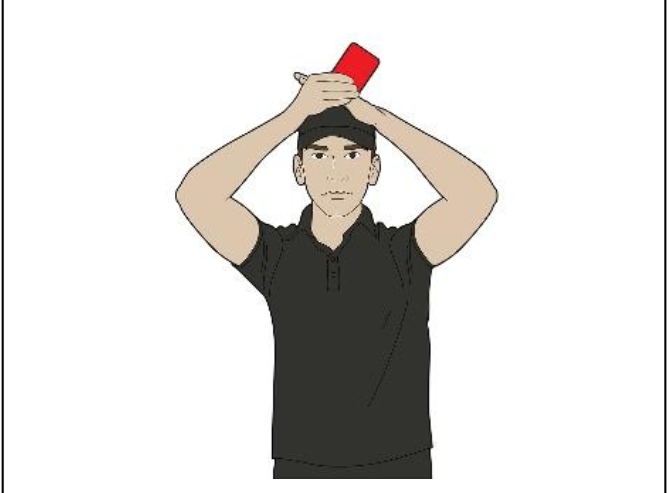
What referee signal is being shown?
Description: Show the red card only, holding the card in one hand,crossed arms with clenched fist above the shoulder (so that it is visible in front and behind) and verbal statement “<answer>” to the player.
Also accepted: EJECTION RED, RED EJECTION
About
This quiz features images and descriptions of various referee gestures from the ICF 2025 Rule Book.
The quiz covers common referee signals including start/infringement, goal signals and fouls. Ideal for anyone wanting to improve their understanding of the game.
Getting nerdy
But how are 'close enough' answers handled?
Consider a correct answer "Time Out". A given input "Timeout" or "Time Outt", should be considered a correct answer, as the quiz aim to validate semantic understanding, and not exact grammar. In computer science such a match is known as 'approximate string matching' or 'fuzzy string matching'.
One way to achieve this, and which is used in this quiz, is through the Levenshtein distance algorithm. The algoritm calculates the minimum number of single-character edits required to change one word into another. E.g. "Time Out" to "Timeout" has a distance of 1 (removing the space). By defining an acceptable error threshold, relative to the word length, minor mistakes can be considered a match. For example, a threshold of 20% for a 10-character word, would allow two character erros.
Sure, but what about sentence ordering?
Sentence ordering is handled by comparing 'bag-of-words'. Two sentences are considered identical if they contain the same words, irrespective of order. E.g. "Goal Disallowed" and "Disallowed Goal" are considered identical. Programmatically this is simply achieved by using sets. Additionally, each word is compared using the previously described Levenshtein distance.
Alright alright, but what about synonyms?
To some extent synonyms are handled by providing multiple correct options. Generally however, synonyms such as "Foul" and "Penalty", must be related through semantic matching. This is a more complex problem, and not handled in this quiz. One way to achieve this, is to use word embeddings, ie. mapping words to high dimensional vectors, and comparing their similarity. This is part of how LLMs like ChatGPT handle "understanding" of words.